
Digital technology has changed the way people interact with music. Instead of experiencing songs only by listening to them, users can now interact with rhythm, notes, timing, and musical patterns through games and other digital tools.
A Piano game is one example of this interactive approach. Depending on the design, it may ask players to tap notes in time with music, respond to falling tiles, identify musical information, or complete game-based exercises connected with piano learning.
The growing interest in music-based games is also reflected in research on digital game-based learning. A systematic review published in Research Studies in Music Education examined 15 peer-reviewed empirical studies published between 2011 and 2023 and found that digital game-based learning has been investigated as a way of combining game experiences with formal and informal music education.
What Is a Piano Game?
A Piano game is a digital game or interactive experience that uses piano-related sounds, notes, rhythms, keys, or musical challenges as part of its gameplay.
Some games are primarily designed for entertainment. Others are created specifically to introduce musical concepts or support structured learning. This difference is important because a game involving piano sounds is not automatically a piano-learning program.
For example, a rhythm game may require players to tap tiles at precise moments while music plays. The main objective can be achieving a high score rather than learning traditional piano technique.
Different Types of Piano Games
There is no single format for a Piano game. Common approaches include rhythm-based games, virtual piano experiences, music-notation games, and educational game-based learning programs.
Commercial examples demonstrate how different these formats can be. Amanotes describes Magic Tiles 3 as a rhythm piano game in which players tap black tiles to the beat of songs. The company currently reports more than 40 million monthly active users for the title and more than 120 million music fans.
How Piano Games Differ From Traditional Piano Lessons
A Piano game and a traditional piano lesson can involve some of the same musical concepts, but their objectives may be very different.
Traditional instruction can cover technique, posture, finger movement, music reading, interpretation, scales, chords, repertoire, and structured practice. A game may instead emphasize timing, reaction, recognition, scoring, or completing challenges.
Digital piano-learning platforms can sit somewhere between these approaches. For example, flowkey describes lessons involving sheet music, two-hand playing, note recognition, and immediate feedback.
How Do Piano Games Work?
Following Notes, Beats, and Rhythms
Many rhythm-oriented games connect player actions with musical timing. Players may need to tap, press, or react when a visual element reaches a particular position.
This makes timing part of the gameplay rather than something the player simply hears in the background.
A Piano game can therefore turn listening into an active task. The player has to watch, listen, and respond rather than simply consume the song passively.
Using Touchscreens, Keyboards, or Virtual Piano Keys
The control method depends on the game. Smartphones and tablets can use touch controls, while computers or connected instruments can provide keyboard-based interaction.
Some educational programs can also combine digital activities with actual piano practice. The 2026 JMIR study, for example, investigated a structured game-based piano education module rather than an ordinary commercial rhythm game.
Scores, Feedback, and Game Progression
Game systems commonly provide some form of feedback, such as points, accuracy indicators, levels, or completion results.
This feedback gives players an immediate indication of how they performed. In an entertainment-focused Piano game, the result may primarily encourage another attempt or higher score. In an educational application, feedback can instead be connected to a learning objective.
Why Are Piano Games So Popular Among Music Lovers?

They Turn Music Into an Interactive Experience
One major attraction is interaction. Instead of only listening to a song, players can respond to its rhythm or musical structure. A Piano game can therefore make music part of an activity that requires attention and action.
This interactive quality is consistent with the broader interest in digital game-based music education identified by the systematic review of research published between 2011 and 2023.
They Combine Music With Game Challenges
Games introduce challenges that traditional listening does not necessarily provide. Players may try to improve accuracy, complete a level, maintain a streak, or beat a previous score. These game mechanics can give a musical activity a clear short-term objective.
However, enjoying these challenges should not automatically be interpreted as evidence of improved musical ability. Research on music games has specifically warned that gameplay tasks do not necessarily train musical skills in a selective or complete way.
Players Can Explore Different Songs and Musical Styles
Song choice can also influence the appeal of a Piano game. Music games may provide access to different songs, arrangements, tempos, or styles.
For music lovers, this can create variety. Instead of repeatedly practicing one exercise, a player may interact with multiple musical tracks.
The size and selection of a music library will depend on the individual game and its licensing arrangements, so song availability should always be checked for the particular product.
They Offer an Accessible Way to Interact With Music
A piano game can be easier to start than formal piano study because some games require only a phone, tablet, computer, or simple controls.
That accessibility does not mean the game replaces a piano. It simply means that some forms of musical interaction can be available without owning a full instrument.
Progress and Feedback Can Encourage Continued Play
Immediate feedback is another important game feature. Seeing an accuracy result or progress indicator can help players understand what happened during a session.
Digital learning platforms also use feedback deliberately. flowkey, for example, states that its system provides instant feedback through note-recognition technology while users practice.
What Features Make Piano Games Engaging?
Music and Song Selection
Music is central to any Piano game. Familiar songs can make the experience more recognizable, while varied selections can provide reasons to continue exploring. The exact quality and size of a library depend on the developer and licensing arrangements.
Different Difficulty Levels
Difficulty systems can allow a game to serve different experience levels. A beginner may need slower patterns or simpler note sequences, while experienced players may prefer faster and more complex challenges.
Rhythm and Timing Challenges
Timing is particularly important in rhythm-based games. Players must coordinate their actions with musical events.
Research reviewing 27 commercially available rhythm-based games found that many required players to react to visual stimuli while music played. The review also concluded that these games did not selectively train rhythmic skills and often lacked the temporal precision required for dedicated rhythmic training.
Immediate Performance Feedback
Scores and accuracy information can show players whether they successfully completed an action. In a learning-oriented Piano game, feedback can be more educational when it identifies specific mistakes rather than simply displaying a score.
Visual and Audio Effects
Animations, sound effects, visual note patterns, and other presentation elements can make gameplay more dynamic.
These features are primarily part of user experience and entertainment. Their presence alone does not demonstrate educational effectiveness.
Levels, Scores, and Achievements
Progress systems provide measurable short-term goals. Players can work toward completing levels or improving previous results. This structure is one reason a Piano game can feel different from unstructured music practice.
Can Piano Games Help People Learn Music?
What Recent Research Says
Recent research provides some encouraging but limited evidence. A 2026 study published in JMIR Serious Games examined an eight-week game-based piano education module involving 60 novice piano learners aged 7 to 12 in Anhui, China. Thirty learners received the game-based intervention and 30 received traditional instruction.
The study reported that the game-based group had higher post-test scores on a standardized Level 1 Basic Music Written Test than the control group.
The intervention included activities such as a Central C game, rhythm-clapping activities, and a music-notation game.
What Researchers Actually Measured
The study measured piano music knowledge, not complete piano-playing ability. The researchers assessed knowledge using a standardized written test and examined areas related to music concepts.
Therefore, the results should be described as evidence about music knowledge within that particular educational intervention. This is a crucial distinction when discussing a Piano game and learning.
What the Research Does Not Prove
The 2026 study does not prove that every commercial piano or rhythm game can teach people to play piano.
It involved a relatively small group of novice children, took place in a specific educational setting, and tested a particular game-based instructional module. The researchers also used a quasi-experimental rather than fully randomized design.
The findings therefore should not be generalized to adults, experienced pianists, every commercial game, or complete piano performance.
Why More Research May Be Needed
The systematic review of digital game-based learning in music education examined 15 empirical studies and demonstrates that the field has been studied, but it also shows that research covers different tools and musical objectives rather than one universal type of game.
More research across different ages, technologies, musical skills, and longer periods of use would help establish where game-based music learning is most effective.
Potential Benefits of Piano Games
Making Musical Activities More Engaging
A Piano game can make a musical activity feel more interactive by combining music with challenges, visual responses, and immediate results. For some users, this format may be more appealing than beginning with conventional exercises.
Opportunities to Practice Rhythm and Note Recognition
Depending on its design, a game may give users opportunities to interact with rhythm, note names, musical notation, or timing. The key phrase depends on its design. Not every game trains the same skill.
Encouraging Interaction With Musical Concepts
Game-based activities can present musical information through repeated interaction. The 2026 piano-learning study provides a concrete example in which game activities were integrated with music education rather than used simply as entertainment.
Supporting Game-Based Music Learning
The broader research literature supports continued investigation of digital games as one possible component of music education. A Piano game can therefore be viewed as a supplementary format whose value depends on its objectives, controls, content, and educational design.
Limitations of Piano Games
A Game Is Not the Same as a Piano Lesson
A game may introduce musical concepts, but formal piano instruction covers a much broader range of skills.
Playing a physical piano involves coordination, technique, dynamics, articulation, posture, hand position, interpretation, and other skills that may not be represented in a touchscreen game.
Gameplay Skills May Not Equal Real Piano Performance
A player can become highly skilled at a game’s control system without automatically becoming a skilled pianist.
The distinction is supported by research showing that many music games do not selectively train the musical skills they appear to involve.
Different Games Have Different Educational Purposes
Not every Piano game is designed to teach music. Some are entertainment products. Others are educational tools. Some combine both purposes.
Consumers should therefore examine the actual features and stated purpose of each game instead of assuming that the word “piano” means formal instruction.
Research Findings May Not Apply to Every Piano Game
Research findings must be connected to the exact intervention that was studied. For example, the 2026 JMIR research examined a specific eight-week educational program with children, not the entire commercial piano-game category.
How to Choose a Piano Game
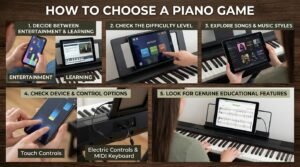
Decide Between Entertainment and Learning
First determine your objective. If you mainly want interactive musical entertainment, gameplay, song variety, and scoring may be the most important features.
If your goal is learning piano, look for structured lessons, note recognition, technique guidance, practice tools, and meaningful feedback.
Check the Difficulty Level
A suitable Piano game should provide challenges appropriate to your current ability. Look for adjustable speed, beginner modes, or progressive difficulty if you want a longer-term experience.
Explore Songs and Music Styles
Check the actual music library before choosing a game. Consider whether it contains the genres, songs, or musical styles that interest you.
Check Device and Control Options
Some games are designed primarily for touchscreens, while others support keyboards or digital instruments. Control options can significantly affect the type of musical interaction the player experiences.
Look for Genuine Educational Features
If learning is your priority, look beyond attractive graphics and high scores. Features such as note recognition, structured exercises, music reading, feedback, practice modes, and progression linked to learning objectives are more relevant indicators.
Piano Games vs. Traditional Piano Learning
| Feature | Piano Games | Traditional Piano Learning |
| Practice | Game-based challenges, notes, rhythm, and scores | Structured practice, technique, and repertoire |
| Equipment | Phone, tablet, or computer | Piano or keyboard |
| Feedback | Scores, accuracy, and game progress | Detailed musical and technical feedback |
| Goals | Entertainment or musical activities | Piano and music development |
| Learning Scope | Depends on the game’s design | Broader piano and musicianship skills |
| Difficulty | Game-based levels and challenges | Progressive lessons and exercises |
| Music | Songs and rhythm-based activities | Repertoire, exercises, and musical pieces |
| Best For | Interactive music experiences | Structured, long-term piano learning |
A Piano game can complement musical practice, but it is not necessarily a substitute for traditional piano instruction.
Final Thoughts
The popularity of piano game and music games can be understood through their combination of music, interaction, challenge, feedback, and accessibility. They give users a way to participate in music rather than simply listen to it.
Research also provides evidence that carefully designed game-based piano education can support specific learning outcomes. The 2026 JMIR study found improved measured piano music knowledge among novice children who participated in a particular eight-week game-based learning program. At the same time, broader research shows that music games vary considerably in their objectives and that gameplay should not automatically be treated as formal musical training.
FAQs About Piano Games
What is a piano game?
It is a digital game that uses piano notes, sounds, rhythms, or musical challenges for entertainment or learning.
Why are piano games popular among music lovers?
A Piano game combines music with interactive controls, timing challenges, songs, and game progression.
Are piano games suitable for beginners?
Yes, some offer simple controls and progressive difficulty, but suitability depends on the game and the player’s goals.
Can a piano game teach you to play piano?
Some can support specific music-learning skills, but they do not necessarily replace comprehensive piano instruction.
Are piano games the same as piano-learning apps?
No. A Piano game usually emphasizes gameplay, while piano-learning apps typically provide structured lessons and practice tools.