
The traditional way of tackling a massive college project usually involves a library, three cups of coffee, and a growing sense of dread. For decades, we have viewed academic labor as a test of endurance rather than a puzzle to be solved. However, the digital age has brought a shift in how we process information, leading many to discover that the most effective way to handle a 5,000-word dissertation isn’t through sheer willpower—it’s through play. By applying the mechanics of video games to the world of academia, students are transforming overwhelming workloads into a series of manageable, rewarding “levels.”
The psychology behind this isn’t just about making things “fun”; it is about dopamine loops and intrinsic motivation. When you play a game, you aren’t thinking about the 40 hours it takes to beat the boss; you are thinking about the next upgrade or the next quest marker. Mastering complex assignments requires a similar mental shift where you break down a semester-long project into milestone tracking and reward systems. Sometimes, the pressure of these milestones becomes too much, and students look to pay someone to do assignment through the experts at myassignmenthelp to ensure their academic progress stays on track while they focus on high-level strategy. This approach reduces cognitive load management and helps maintain a flow state, ensuring that the brain doesn’t hit a wall of study fatigue.
The Science of the “Quest” Mentality
In gaming, a quest is rarely one single action. It is a chain of events: gather resources, travel to a location, and complete a challenge. When you view a complex assignment as a “Main Quest,” the sub-tasks become your “Daily Challenges.” For instance, a literature review isn’t just a boring reading list; it’s a resource-gathering mission. Every peer-reviewed source you find adds to your “Intelligence Stats.”
This method works because it targets the brain’s reward system. Instead of waiting weeks for a grade to feel successful, you feel a sense of achievement every time you clear a sub-task. This is the core of game-based learning. By using progress bars—even if they are just hand-drawn in your notebook—you provide your brain with the visual feedback it craves to stay engaged. This keeps procrastination at bay by focusing on the “next level” rather than the final, distant goal.
Comparing Traditional Study vs. Gamified Study
To understand why this ranks as a superior strategy for modern students, we can look at how the two methods handle the same workload.
| Feature | Traditional Study Method | Gamified Academic Method |
| Primary Driver | Fear of deadlines (Extrinsic) | Achievement & Progression (Intrinsic) |
| Task Structure | Large, amorphous blocks of work | Modular “Quests” and “Side-Missions” |
| Feedback Loop | Delayed (Weeks after submission) | Instant (Points, XP, or Task Completion) |
| Engagement | High stress, low engagement | High focus (Flow State), lower anxiety |
| Resource Use | Solitary grinding | Strategic delegation and tool usage |
Building Your Academic Tech Stack
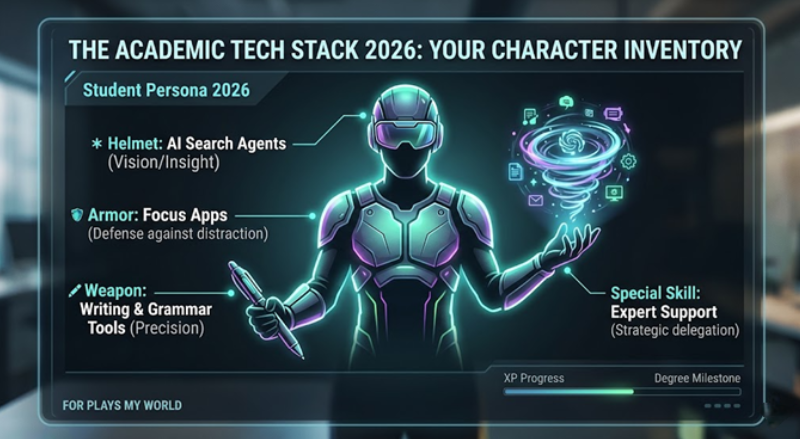
To truly gamify your studies in 2026, you need the right digital tools. We are moving beyond simple planners and into the era of AI study agents and VR learning environments. Imagine a digital workspace where your physics problems are visualized in 3D or where your history notes are archived like an in-game codex. These tools help in reducing assignment anxiety by making the information more interactive and less abstract.
When dealing with technical subjects like data analysis or advanced mathematics, the complexity can sometimes outpace the time you have available. If you find yourself stuck on a difficult spreadsheet project, you might choose to search for help to do my excel homework to keep your overall project momentum from stalling. Above all, maintaining your “Academic XP” is about knowing when to use the right tools for the job.
Leveling Up: Managing the Burnout Boss
The biggest threat to any student’s “playthrough” is academic burnout. In the gaming world, this is the equivalent of a “Game Over” screen. Burnout happens when the difficulty curve of your semester rises too sharply without enough “save points” or breaks. Gamification teaches us the importance of the “Rest Mechanic.” Just as a character needs to regenerate health, a student needs planned intervals of recovery to maintain high-level student engagement.
By implementing quest-based tasks, you can schedule these recovery periods as “unlocked rewards.” Finished the first draft of your methodology? That’s an hour of your favorite actual video game unlocked. Completed your bibliography? That’s a night out with friends. This creates a healthy relationship with your work where the assignment is no longer an enemy to be feared, but a series of challenges designed to be overcome.
Breaking the Cycle of Procrastination
Procrastination is often just a symptom of a task feeling too large to start. Game designers solve this by giving players a very easy task at the beginning of a game—a tutorial. You can do the same with your essays. Don’t start by trying to write the perfect introduction. Start by “logging in” and simply formatting your document. This low-stakes entry point breaks the initial resistance.
Once you have started, the momentum of milestone tracking takes over. You aren’t just writing an essay; you are clearing objectives. This shift in perspective is the secret to why gamification is so effective for the modern student. It turns a passive, often boring process into an active, strategic experience.
The Psychology of Narrative Achievement
Every great game has a story. Your academic journey is no different. When you frame your degree as a narrative of growth, every complex assignment becomes a pivotal plot point. This narrative framing is what separates top-performing students from the rest. They don’t see themselves as “victims” of a syllabus; they see themselves as protagonists developing their skills.
This is where “Information Gain” becomes critical for SEO. Content that explains why we fail—usually due to a lack of narrative agency—provides more value than a simple list of tips. By understanding that your brain is wired for story and reward, you can hack your biology to make studying feel less like a chore and more like a competitive advantage.
Strategic Resource Management
In high-level strategy games, success isn’t just about how fast you click; it’s about how you manage your resources (Time, Energy, and Focus). Students in 2026 are increasingly treated like “knowledge athletes.” This means you must be ruthless with your time. If a specific task, like a repetitive data entry project or a particularly dense literature search, is draining your “Mana” (mental energy) without adding to your learning, it is a strategic error to do it yourself.
he Future of Learning in 2026
As we look forward, the line between “work” and “play” will continue to blur. Educational institutions are already beginning to adopt academic leveling systems, where grades are earned like points and students have more agency in how they demonstrate their knowledge. Whether you are using digital productivity tools to track your habits or seeking professional support to manage a heavy coursework load, the goal remains the same: mastery.
In conclusion, mastering complex assignments doesn’t have to be a joyless grind. By embracing the principles of gamification—breaking down goals, rewarding progress, and using the best resources available—you can navigate your academic career with the same precision and excitement as a professional gamer. The challenges might be real, but with the right strategy, the “Win Condition” is always within your reach. Focus on the progression, celebrate the small wins, and remember that every expert was once a level-one player who simply refused to quit.
Frequently Asked Questions
How does turning work into a game improve focus?
It shifts the brain’s focus from a daunting end goal to immediate, achievable objectives. This creates a consistent feedback loop that triggers motivation and helps maintain a state of deep concentration for longer periods.
Can these methods work for subjects that aren’t naturally interactive?
Yes. Any project can be structured into a series of “missions.” By setting specific milestones and personal rewards for completion, you create an artificial progress system that makes even dense, theoretical research feel more dynamic.
What is the best way to start gamifying a semester?
Begin by mapping out your syllabus as a skill tree or progress map. Assign “experience points” to different tasks based on their difficulty and importance, then track your growth visually as you complete each one.
Is it necessary to use specific apps to see results?
While digital tools can help automate tracking, the core benefit comes from the mental shift. A simple notebook with a progress bar or a physical reward system can be just as effective at reducing the stress of a heavy workload.
About The Author
Ella Thompson is an experienced academic strategist and content contributor for myassignmenthelp, where she focuses on student productivity and modern learning trends. Passionate about educational technology, Ella specializes in translating complex study methods into actionable advice for the next generation of learners.